Thursday, March 17, 2011

Clam and potato stew

I'm always intrigued by how certain combinations of food become fixed. It's more obvious in Spain, where there is both a more extensive repertoire of traditional dishes and a more conservative approach to cooking (facts which I guess are related).


I was in the market today shopping for fish and, as usual, not quite sure what to buy when I spotted some nice-looking clams at 6 euros a kilo. I usually just cook clams a la marinera, with paprika and sherry, but I wanted something that would turn them into a one-pot meal. At first, I thought about doing them with rice, but then it struck me that they would be good in a potato stew. In Cadiz, the usual thing to combine with potatoes like this is cuttlefish (papas con choco) but it worked very well with the clams and I will definitely be repeating this one. I think I might also try to work out a curried version with coconut milk and turmeric at some point.

Ingredients

1 head of celery
2 cloves of garlic
olive oil
2 teaspoons of smoked paprika
1 teaspoon of cumin
2 kg of potatoes
1/2 kg of green beans
4 ripe tomatoes
1 teaspoon of salt
1 glass of white wine
1 glass of chicken stock (or replace with fish stock or water)
2 bay leaves
1 kg of clams


Method
  1. Clean and chop the celery and garlic, and fry gently in plenty of olive oil.
  2. Peel the potatoes and cut them into large chunks. Cut the green beans into 2-inch segments. Cut the tomatoes into large chunks. Wash the clams thorough in plenty of cold water.
  3. Once the celery begins to soften, add the paprika and cumin and fry for 30 seconds or so before adding the potatoes, beans, tomatoes, wine, stock, bay leaves and salt.
  4. Bring to a boil, turn heat to low, cover and simmer gently until the potatoes are just done.
  5. Add the clams, stir well, cover and continue cooking for a few minutes until all of the clams have opened.

Saturday, March 5, 2011

Pork meatballs with squid, in a green curry sauce

I'm always a little nervous when people introduce me as a foodie. It's true that I love food and love cooking, but I would hesitate to describe myself as a good cook. I'm well aware of my shortcomings - gaps in my knowledge and my technique, and the more than occasional mediocre dish that I produce.


However, every now and then I cook something that makes me think that maybe I do deserve to be described as a good cook. It's usually when I bring together some slightly unusual ingredients in an inspired combination that I have not knowingly copied from anywhere else, and this was the case with this meatball curry that I cooked up this evening, having spent the day out drinking beer on the first Saturday of Carnival. The ingredient which lifts it up onto another level is the inclusion of some squid in the meatball mixture.

Ingredients
meatballs
100g squid, cut into small pieces
1 leek
2 cloves of garlic
1-inch piece of fresh ginger
500g minced pork
2 tbsps light soy sauce
1 tbsp white wine
2 tbsps green chilli chutney (substitute with 1 tbsps of minced green chilli and 1 tbsps lemon juice)
4 tbsps breadcrumbs

sauce
vegetable oil
1 onion

2 cloves of garlic

1-inch piece of fresh ginger
4 kaffir lime leaves
1 stalk of lemongrass
1/2 tin of coconut milk
1 tbsp fish sauce

2 tbsps green chilli chutney (substitute with 1 tbsps of minced green chilli and 1 tbsps lemon juice)


Method
meatballs
  1. Peel and chop the garlic and ginger, and wash and chop the leek. Put the cuttlefish, leek, garlic and ginger into a food processor, and chop finely. Transfer to a large bowl, add the pork, soy sauce, wine, chilli chutney and breadcrumbs, mix well, return to the food processor and whizz briefly.
  2. Form the mixture into walnut-sized chunks and fry in vegetable oil until browned. (You will probably need to do 2 or 3 batches.) Remove to a plate.

sauce
  1. Peel and chop the onion, garlic and ginger, transfer to food processor and chop finely.
  2. In a medium saucepan, fry the onion mixture gently in vegetable oil. Once the onion has softened, add the coconut milk, kaffir lime leaves, lemongrass, fish sauce and green chilli chutney, and stir well.
  3. Bring to a simmer, then add the meatballs, cover the pan and cook for 10 minutes. Serve with rice.

Saturday, November 27, 2010

Tripe with chickpeas (menudo gaditano)

Mention tripe in the UK and you're bound to get a chorus of disparaging remarks and expressions of outright disgust. The conventional explanation is that it came to be seen as poverty food during World War Two, but I don't think that is the whole story. There is obviously something a bit deeper behind the move away from offal in the British diet, and the same trend can be seen in Spain, although not to the same extreme.


I suspect a number of factors have come together to push tripe and other offal off our menus.
  • Increased wealth means that high prestige meats (steak, lean mince, chicken etc.) are now widely accessible and relatively cheap, so there is less incentive to eat the cheaper cuts.
  • This, in turn, means that these high prestige cuts become the norm, and set the standard of what meat should be like.
  • On top of this, increasing health consciousness puts people off consuming fattier meats or any meat (such as tripe) which looks as if it might be fatty.
  • More generally, there has been a move away from gelatinous textures, to the point where just about the only gelatinous foods eaten with any regularity in the UK are jelly itself and creme caramel. Meat can be tender, crisp or firm, but never gelatinous.
In Spain, tripe is far more widely eaten in the UK, but it is definitely still a little old-fashioned, the kind of thing generally eaten by people in their 50s upwards and a few younger men who think that 'nose to tail' eating is cool. (I guess that includes me.) I often eat it in bars, but have never made it at home, partly because nobody else in my family eats it.

However, I decided it was time to break it out of the ghetto, hoping that even if the tripe itself went uneaten, the chickpeas would be a success. I also took the liberty of adding some green beans and a red pepper to make it a bit more interesting, although this is definitely not part of the traditional recipe.

Ingredients
olive oil
500g mixed tripe (plus a bit of trotter)
500g dry chickpeas (soaked overnight)
plain flour
1 onion
3 cloves of garlic
3 bay leaves
1 red pepper
chicken stock
3 tsps salt
3 tsps paprika
1 tsp tabasco
white wine
green beans

Method
  1. Wash the tripe in cold water (it should already have been prepared by the butcher), and cut into small pieces.
  2. Peel and chop the onion, peel and crush the garlic, cut the red pepper into small chunks, and top and tail the beans and cut them into pieces.
  3. Put plenty of olive oil in a pressure cooker, add the onion and garlic and fry for a couple of minutes
  4. Meanwhile, dust the tripe in flour, then add it to the onion and garlic and fry for a few minutes until browned.
  5. Add the chickpeas, red pepper, paprika, a splash of white wine, salt, tabasco and enough chicken stock to barely cover the ingredients, bring to a boil, put the lid on the pressure cooker, bring up to full pressure, reduce heat to minimum and cook for 50 minutes.
  6. Turn off heat, allow pot to cool fully, open, add the green beans, cover the pot, bring back to pressure and cook for a further 5 minutes.
  7. Like all stews, this benefits from sitting for a day.
Tweaking
When I made this, I more or less followed a traditional recipe. However, the result was a little watery and bland for my liking. It was partly my fault, for not using hot enough paprika, so I rectified it with some tabasco. I also made a little roux with some olive oil and flour and gradually ladled some of the liquid into it to create a thicker, silkier sauce - obviously the sensible point at which to add the flour is at the beginning.

A load of tripe (menudo menudo)
When I was buying my tripe, I made the mistake of being too vague with my ordering. I asked for a little bit of tripe (un poquito de menudo) but what I got was 2 kg of assorted cow's stomach, with a trotter thrown in for good measure. Next time I shall be more specific, but in the meantime I have a couple of bags of tripe waiting in my freezer.

Wild rabbit with Spanish olives

All of a sudden, it's hunting season in Andalucia. It's a bit of a pain if you go into the country, as the place is teeming with guys in camouflage and guns taking potshots at anything that moves, but on the upside stalls all over the market are suddenly offering rabbit, hare, partridge, venison and pigeon, which makes a welcome change from beef and pork.


When I went along to my butcher's the other day, a whole section of his counter was packed full of cute-looking furry bunnies, nestling in among the pots of manteca colorada, so I thought I would try a wild version of my rabbit stew with olives. It seemed only right to honour the wild rabbit with some of Matias' fat verdial olives instead of the tinned black ones I had used the previous time.

Ingredients
1 rabbit, cut into joints
plain flour
olive oil
6 sticks of celery
1/2 onion
2 carrots
3 cloves of garlic
250 g of marinated Spanish olives, together with their marinating liquid
4 ripe tomatoes
a splash of white wine
1/2 teaspoons of salt
2 teaspoons of dried rosemary

Method
  1. Peel and finely chop the onion, slice the celery, peel and slice the carrots, peel and roughly crush the garlic.
  2. Heat plenty of olive oil in your pressure cooker (with the lid off, obviously!), dust the rabbit pieces in plenty of flour, and brown them on both sides in the hot oil. Remove the browned pieces to a plate.
  3. Gently fry the onion, celery, carrot and garlic in the oil.
  4. Return the browned rabbit pieces to the pot, add the tomato, olives (including any marinade liquid), rosemary, salt and a splash of wine, and put the lid on. Bring up to pressure, reduce heat to minimum and cook for 20 minutes.

Sunday, October 24, 2010

Rabbit stew, hunter's style (coniglio alla cacciatore)

I posted a recipe for some rather dry lentils the other day, and was happy to receive a comment from a reader about the right proportions of liquid. I've since corrected my lentil post (lentils with chorizo and dried wild mushrooms) and updated the photo, but in the meantime I also took a wander over to my reader's site, which is dedicated exclusively to the art of the pressure pot and goes by the name of hip pressure cooking. This recipe is inspired by a version I found there, and I think the combination of a bit of non-pressure cooking (sauteeing, browning etc.) and then pressure stewing is perfect. Incidentally, I was a bit scared of tipping in the brine from my tin of olives, but I did, and the result was great. (For this reason, no salt is listed in the recipe.)


Ingredients
1 rabbit, cut into joints

marinade
150 g white wine vinegar
150 g white wine
150 g water
6 bay leaves

stew
plain flour
olive oil
3 sticks of celery
1/2 onion
2 carrots
3 cloves of garlic
350 g tin of black olives
1 tin of tomatoes
250 ml of red wine
1 teaspoon of dried rosemary (or a large sprig of fresh)

Method
  1. Put the jointed rabbit in a large bowl with the bay leaves, cover with the vinegar, wine and water, and leave to marinade in the fridge overnight.
  2. Remove the rabbit pieces from the marinade, and discard the liquid. Peel and finely chop the onion, slice the celery, peel and slice the carrots, peel and roughly crush the garlic.
  3. Heat plenty of olive oil in your pressure cooker (with the lid off, obviously!), dust the rabbit pieces in plenty of flour, and brown them on both sides in the hot oil. You will probably need to do them in three batches. Remove the browned pieces to a plate.
  4. Gently fry the onion, celery, carrot and garlic in the oil. After a few minutes, remove to a bowl, together with any oil.
  5. Deglaze the pan with a good splash of wine, scraping the pan with a wooden spoon, then add the rest of the wine, bring to a boil and simmer for 10 minutes to boil off the alcohol.
  6. Return the browned rabbit pieces and fried vegetables to the pot, add the tomato, olives (including the brine) and rosemary, and put the lid on. Bring up to pressure, reduce hit to minimum and cook for 20 minutes.

Tuesday, October 12, 2010

Banana bread

Nine months ago I started making a batch of focaccia in my kitchen, and today I finished! Okay, it didn't take me nine months to make the bread, but that is how long it took us to get the oven fixed. (It's a long story, and there were mitigating circumstances.) Anyway, I felt the oven needed to be shown who was boss, so I made a point of taking up where it had so rudely interrupted me back in January, and produced a tray of focaccia.

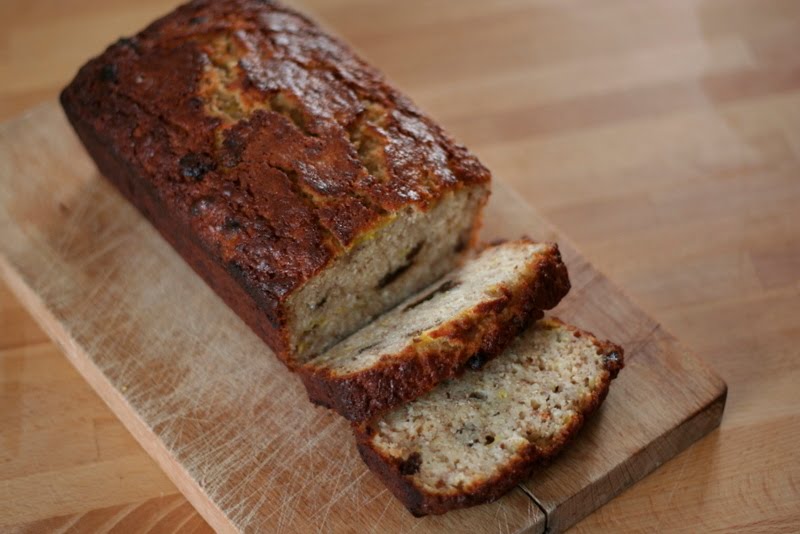
Next up for the great oven celebration was some banana bread. I got a recipe from the BBC Food Website, and tweaked it a little. Apart from being really easy, and quite delicious, it's a great way of using up those guilt-inducing overripe bananas which everyone seems to have in their fruit bowls.


Ingredients
140 g self-raising flour
1/2 tsp salt
1 tsp ground cinnamon
60 g butter
110 g caster sugar
1 egg
2 ripe bananas, mashed
35 ml milk
1/2 tsp vanilla extract
1 tsp lemon juice

Method
  1. Set the oven to 180oC, and line a loaf tin (20 cm x 10 cm)
  2. Sift the flour into a bowl and add the salt and cinnamon.
  3. In a separate bowl, cream together the butter and sugar.
  4. Add the bananas, milk, eggs and vanilla extract to the butter and sugar mixture, and mix well.
  5. Fold the flour into the resulting batter, mix well and add the lemon juice.
  6. Pour the mixture into the loaf tin, bake in the preheated oven for 45 minutes until golden.
  7. Allow the bread to cool in the tin for 5 minutes before transferring to a rack.

Wednesday, October 6, 2010

Salt cod mayonnaise

I made this with the leftover pil-pil sauce and cooking oil the last time I made bacalao al pil pil (which is salt cod in a warm mayonnaise). The original recipe has 500 ml of olive oil, of which only half is used in the pil pil sauce. So you already have 250 ml of cod-flavoured olive oil going spare. On top of that, there will probably be some leftover pil pil sauce. When I saw that I had getting on for 350 ml of top quality olive oil about to go to waste, I suggested to Gemma that I make it into mayonnaise. She looked at me as if I was a bit mad, but I made it anyway.


Ingredients
leftover olive oil and pil pil sauce from bacalao al pil pil

Method
Put the olive oil and leftover sauce in a bowl, and whisk gently until it liaises to form a light mayonnaise.

This made a really good mayonnaise, which was quite light and had a delicate flavour of cod. I knew that nobody else in my family would knowingly eat it, but I tricked them by using it to dress some spaghetti with salt cod, chick peas and green peppers, which they all ate happily. (I had an extra serving of mayonnaise on top of mine.) They will only realise they ate the mayonnaise too if they read this blog entry!

Googlewhack!
As I was writing this entry, I thought I would have a quick search to see if anyone else makes salt cod mayonnaise. I came across a reference to a restaurant in Dublin called Pichet which sometimes has it on their menu, but no actual recipes, so I think this counts as a culinary googlewhack.