Showing posts with label British. Show all posts

Saturday, June 28, 2025

Raspberry jam

Even the best shop-bought or cottage industry jam can't compete with a good homemade batch. There are just three keys to making it well at home:

  • use good quality fruit (and don't bother to wash it)
  • don't try to make too much at once (less is more)
  • if you're not sure whether your jam has set yet, then it hasn't.


Ingredients

(makes two small jars)

  • 650g raspberries
  • Juice of 1/2 lemon
  • 150ml water
  • 500g granulated sugar

  1. Put a clean saucer in the freezer for the wrinkle test.
  2. Put the fruit, lemon juice and water in a large saucepan, and simmer gently for a few minutes, then add the sugar, and simmer until dissolved.
  3. Bring the jam to a rolling boil, and boil for about 10 minutes, until you think it has reached setting point. (105oC, if using a thermometer; by eye/ear, when the bubbles on the jam become large and start to plop).
  4. Remove from the heat and test for a set by placing a blob of jam on your cold saucer, leaving it to cool in the fridge, then push the blob with your finger. If the surface wrinkles and your finger leaves a trace, the jam has set. If the jam hasn't set, bring it back to the boil and cook for another minute or so before testing.
  5. Transfer the hot jam into sterilized jars, seal with sterilized lids and allow to cool.


Saturday, August 26, 2023

Plain scones

 The secret to a good scone, in my opinion, is to knead the dough lightly and shape by hand. If you don't knead the dough enough, the scone will be too crumbly; knead it too much or - heaven forbid! - roll it out, and your scone will be too heavy.


Ingredients

300g self-raising flour
50g caster sugar
75g butter
160ml milk

Method

  1. Heat the oven to 180oC. Sift the flour into a mixing bowl, add the sugar, cut the butter into small pieces and add to the flour and sugar mixture, rubbing it gently with your fingertips until it is the texture of breadcrumbs.
  2. Add the milk, mix with a spoon, and then knead gently until you have a smooth dough.
  3. Divide the dough into eight even pieces, form each piece into a ball, and flatten slightly to form a fat, rough disk. Any cracks and folds will add texture to the finished scone.
  4. Place the rounds on a lightly floured baking sheet and bake for about 14 minutes, until they are golden.

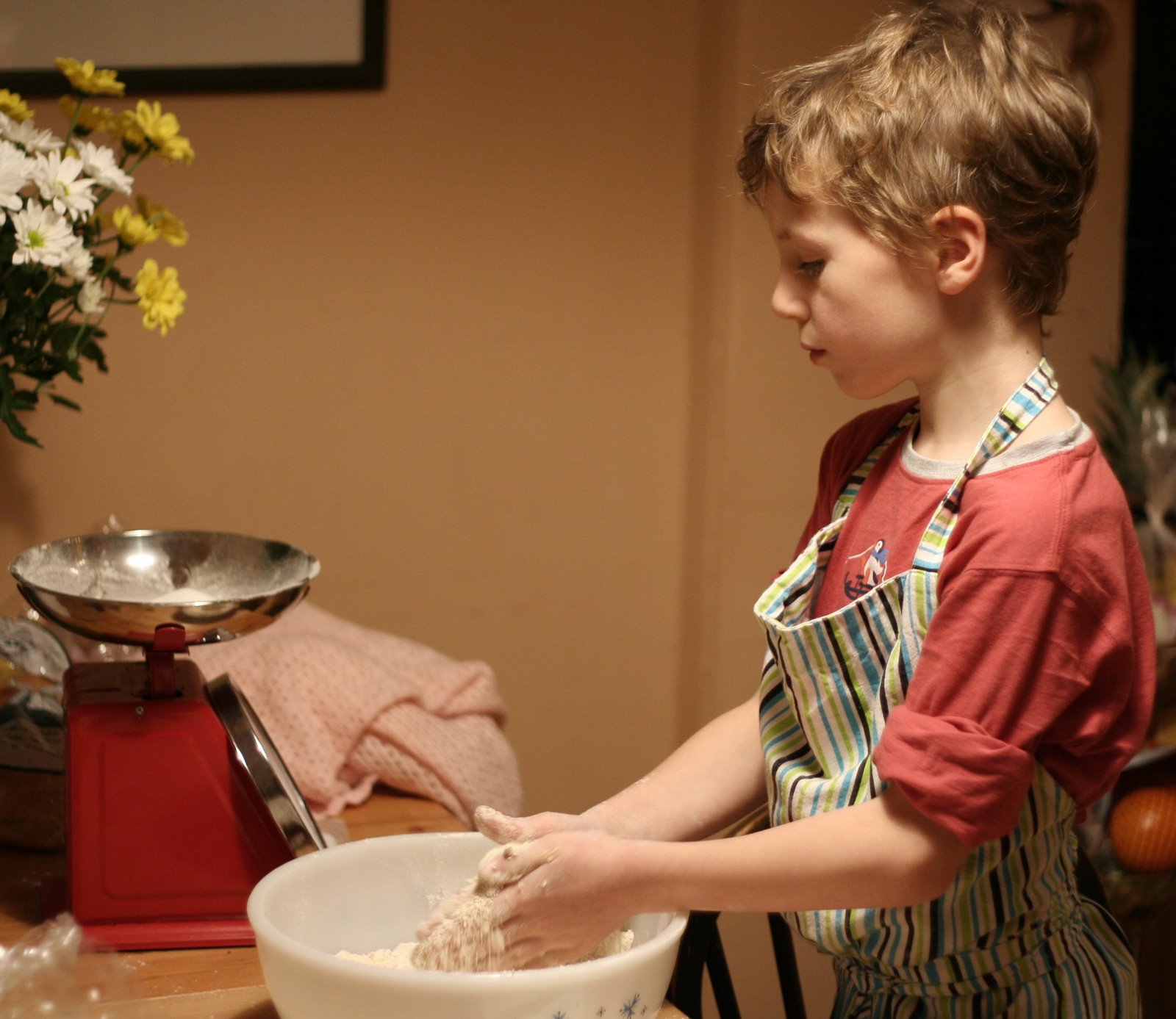
I've been making scones for years but I have to confess that it took me a while (okay, years!) to realise that, while not rolling and cutting them was fine, I'd gone too far in the other direction and that by barely kneading the dough at all my scones were crumblier (and heavier) than they should have been. Nonetheless, I have lots of happy memories of making scones with my kids for friends and family, so here are a couple of photos from the archive.


Sunday, April 1, 2012

Flapjacks

One of the underrated aspects of British food culture is our tradition of home baking. These flapjacks are really easy to make, and taste delicious. If you want, you can jazz them up a bit with some ginger or dried fruits.


Ingredients
200g unsalted butter
200g demerara sugar
200g honey
400g porridge oats

Method
  1. Line and grease a swiss roll tine and set the oven to 180oC.
  2. Put the butter, sugar and honey in a medium saucepan and heat gently until the butter has melted and the sugar has dissolved.
  3. Add the porridge oats, mix well, and transfer to the prepared tin.
  4. Bake for 20 minutes. Leave to cool in the tin, then turn out and cut into squares.

Saturday, December 24, 2011

Victorian mulled wine

It annoys me when something old and traditional is repackaged and sold as if it is new and exotic, especially if the new version is inferior to the old one. Every year I go through Halloween trauma, when the shops are filled with garish orange pumpkins and plastic vampire teeth, and my suffering is only slightly relieved by being able to buttonhole the occasional American and lecture them on the Scottish origins of the festival and the joys of turnip carving. Last year I was lucky to have a resident American in the form of Kaya's dad Jordon to play this part, and this year the role has been filled by our new friends Beth and Josh. I apologies to all of you for making you the recipients of my curmudgeonly rantings.

With Halloween barely over it is German Christmas Market time in Edinburgh and just about everywhere else in the UK (or Weihnachtsmarkt as they call it in Frankfurt). I'm partial to the odd bratwurst myself and am quite happy to browse stalls loaded with little wooden Christmas ornaments, but I draw the line at their  gluhwein. The problem starts with inferior wine, and is then compounded by excessive sugar, heavy-handed spicing, and stewing the wine. The result is a mug of expensive cough medicine.


So I decided to make some traditional Victorian mulled wine. The sugar, spices and citrus should be identifiable without being overpowering or sickly, and preparing a syrup which is then strained and added to the wine, which is in turn gently heated, has a number of advantages. You don't get any of the nasty bitterness from leaving the spices and citrus sitting around in the wine, you are not at risk of choking on the whole cloves floating around in your drink and, last but not least, you don't reduce the alcohol content of the wine by cooking it off.

Ingredients
250ml water
175g brown sugar
6 cinnamon sticks
2-inch chunk of fresh ginger, peeled and sliced
1 teaspoon of cloves
zest of 1 orange
2 bottles of red wine (I used a Chilean merlot)

Method

  1. Combine the water, sugar, cinnamon, ginger, cloves and orange zest in a small saucepan. Bring to a boil, reduce to a simmer and cook until you have a thick syrup.
  2. Pour the wine into a large saucepan, strain the syrup into it, and heat well but take care not to boil or to allow it to simmer. Serve immediately or turn off the heat and cover the pan.
Photo credits
Together with my mulled wine, this photo features Gemma's handmade Scandinavian wooden advent calendar.

Tuesday, April 15, 2008

Shepherd's pie with calf’s tongue

Don’t allow your prejudices to put you off. Tongue is lean and very tender, and tastes just like any other cut of beef you would use for making a stew. (The flavour is, if anything, slightly milder.) I’m not sure why the standard recipes all involving pressing and pickling rather than simple stewing. This seems to imply an irreducible toughness and strong flavour, neither of which could be further from the truth.


I bought this tongue from my butcher, Antonio, the other day. He kindly peeled it for me. You can do it yourself with care and a good sharp knife – you will lose a little meat in the process, but don’t worry about that. Or simply plunge the whole thing into boil water, take it out again and the skin will slip off easily (or so I’m told).

Ingredients
1 calf’s tongue, peeled (see above)
1 onion
4 cloves of garlic
½ bottle of red wine
4 bay leaves
salt
pepper
water
2 kg of potatoes
milk
butter
4 tsps dijon mustard
salt
pepper

Method
  1. Chop the onion, put in a good-sized saucepan with some olive oil, and fry gently. Once the onion is translucent, add the chopped garlic cloves and fry for another minute or so.
  2. Cut the tongue into good sized chunks, add to the saucepan, and brown. Then add the wine, bay leaves, season with salt and pepper and add some water so that the meat is covered.
  3. Bring to the boil, then turn the heat down to minimum and simmer gently with the lid off for the first 15 minutes (to allow the alcohol to evaporate) and then with the lid on for another 1½ hours or so. Check the liquid levels from time to time and top up if the meat starts to dry out. When done, the dish should have plenty of sauce and the meat should be very tender.
  4. Peel the potatoes, cut them into smallish chunks (quarters or eighths, depending on the potato) and steam until well done. Set aside the steaming liquid and use as a vegetable stock.
  5. Put the steamed potatoes in a large bowl, add plenty of milk and butter, mustard, salt and pepper, and mash until fairly smooth, adding more milk and butter if required. (As everyone in my house is lactose-intolerant, I tend to use the steaming liquid and olive oil as a dairy-free alternative.)
  6. Put the stewed tongue in the bottom of a ceramic oven dish, cover with mashed potato, and cook in an oven preheated to 190°C until the potato begins to go brown and crispy on top.