Showing posts with label fish. Show all posts

Monday, August 7, 2023

Pickled herring

I like the seasonality of herring, the fact that it is only available for a few months during the summer. I was in the fishmonger the other day (Williamson of Portobello) and behind me was a large Russian lady with bright pink hair. We were both in for some fresh herring to pickle but unfortunately they had sold out. The fishmonger offered us some of their ready-pickled herring instead but we both turned it down ("too soft" I said, "too vinegary" the Russian lady said) and instead got to chatting about the best way to pickle herring (and why the shop-bought stuff was inferior). The Russian lady was originally from Odessa. She recommended adding some vodka to the marinade. It was another couple of weeks before I got back to the fishmonger. They had plenty of fresh herring this time but there was no sign of the Russian lady.


I eat and cook very differently from my grandparents, but there are a few overlaps and they have great emotional weight. This is one of them - there was always a jar in my grandparents' fridge (shop bought, though - suspect my grandmother would have thought this home-pickling of mine was madness).

Ingredients

6 herring, filleted
1/2 onion
20g of fresh dill

For the marinade

300 ml of cider or white wine vinegar
300 ml of water
2 teaspoon of whole coriander seeds
2 teaspoon of white mustard seeds
2 teaspoon of black peppercorns
2 teaspoon of salt
2 teaspoon of caster sugar

optional: 3 tablespoons of vodka or gin

  1. Place all the marinade ingredients in a small saucepan, bring to a boil, stir to make sure the salt and sugar are fully dissolved, and leave to cool.
  2. If the herring fillets are still attached, separate into two halves, lengthwise. Finely slice the onion.
  3. Place a layer of onion in the bottom of a rectangular tupperware (one that is just long enough for the herring), cover with some fresh dill, pour a little of the cooled marinade over it (through a tea strainer), then place a layer of herring fillets on top. Repeat until you have used up all the herring. If you have any onion and dill left, put some on top, pour the remaining marinade over the fish so that it is covered, put the lid on the dish and leave to pickle in the fridge for three or four days.

Sunday, January 10, 2016

Salt cod fritters (bolinhos de bacalhau)

This recipe is adapted from a rather charming comic-strip version by Len Deighton (the spy author). I've tweaked it a bit as the proportions in the original were slightly wrong, causing the fritters to fall apart on contact with the hot oil! The salt cod comes from our local Portuguese cafe, Casa Amiga, where I often go with Sammy to read the papers, drink coffee and eat custard tarts.


Ingredients
500g salt cod
500 ml milk
2 bay leaves
1 kg potatoes
4 eggs
1 handful of parsley
1/2 tsp salt
plain flour
breadcrumbs

Method
  1. Wash the salt cod well, and leave it to soak in plenty of water, in the fridge, for at least 48 hours, changing the water every 24 hours. (It will keep like this for several days, so don't feel obliged to use the cod on Wednesday just because you started soaking it on Monday.)
  2. Put the rinsed cod in a small saucepan with the milk and the bay leaves, bring to a boil, cover and simmer on a low heat for about 30 minutes, until the cod is soft. Remove the cod from the milk.
  3. Peel and dice the potatoes, add to the fishy milk, bring to a boil, cover and simmer on a low heat for about 20 minutes, until the potatoes are cooked.
  4. Strain the milk off into a jug, remove and discard the bay leaves..
  5. Beat one of the eggs, add it to the potatoes together with a little of the reserved milk and mash the potatoes.
  6. Chop the parsley and add it to the potato, together with the salt.
  7. Remove the skin and any bones from the cod, break the cod into flakes, add to the potato and mix well. If the mixture is too dry, add a little more milk.
  8. Beat the remaining three eggs.
  9. Use two dessert spoons to shape the cod and potato mixture into quenelles.
  10. Coat the quenelles in flour, then in beaten egg, and finally in breadcrumbs. (See photo below.)
  11. Fry the fritters in plenty of oil until they are golden on the outside.

Friday, January 25, 2013

Cod's roe with tomato and green pepper (huevas aliñadas)

Huevas aliñadas or dressed roe is a standard cold tapa in Cádiz, and is a big favourite of Sammy's. There was some cod's roe in my Edinburgh fishmonger the other day, so I bought it and made this simple cod's roe salad for Sammy to welcome him back from his skiing trip with Grandma and Auntie Clara.


Ingredients
250g cooked cod´s roe
2 tomatoes
1/2 green pepper
2 spring onions
3 tbsps olive oil
1.5 tbsps vinegar
1/2 tsps salt
black pepper

Method
Cut the cod's roe into smallish pieces (about 2cm square), dice the tomatoes and green pepper, and slice the spring onions. Combine in a bowl, dress with the olive oil, vinegar, salt and pepper, mix well, and leave to sit for at least 30 minutes before serving.

Sunday, August 15, 2010

Arbroath smokies

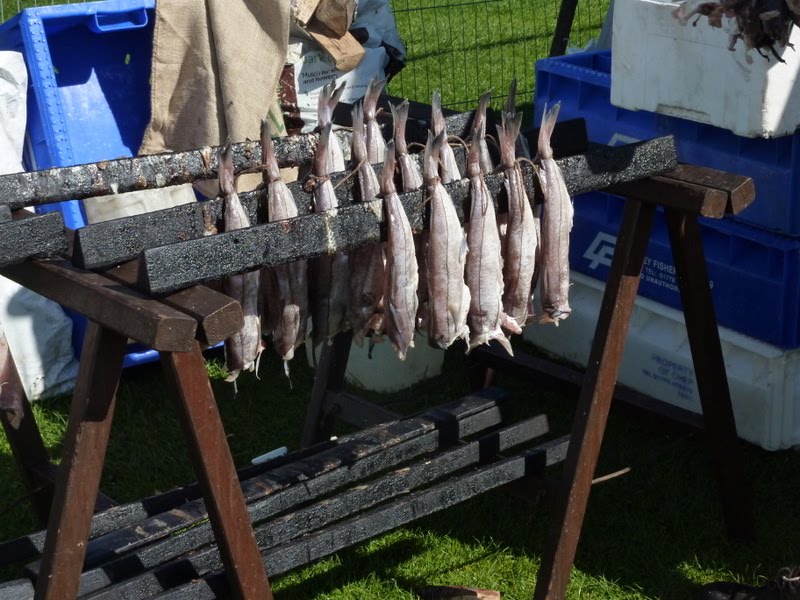
I was at the Foodies Festival in Edinburgh and was lucky enough to see Iain Spink smoking his haddock on site. The process itself is pretty simple: the fish have their heads removed and are gutted and cleaned, before being tied in pairs and hung over a stick.


Next, the stick itself is placed over a half barrel, with a fire of beech and oak burning inside it.


Then the barrel is covered with a few layers of damp hessian.


After half an hour or so, the Arbroath smokies are ready.


Arbroath smokies keep for a while, and perhaps the most famous dish in which they feature is Cullen skink. They are also good in a potato salado. However, the best way to serve them is definitely hot from the barrel.

Saturday, July 31, 2010

Warm Arbroath smokie, potato and bacon salad

When I got back from Amsterdam I was in the mood for more herring, and I nipped along to my fishmonger (Something Fishy, on Broughton Street in Edinburgh) expecting to find some nice fat herrings waiting for me. Unfortunately they had all gone, so I bought some Arbroath smokies instead. Smokies are hot-smoked, salted haddock which are a north-east of Scotland speciality, and bear no resemblance to herring, but I thought they would still go well in the warm potato and bacon salad I had planned for the herring. If you can't get hold of smokies then you could substitute them with fresh herring fillets, very lightly fried, or just about any other fish you fancy - mackerel, trout etc.


Ingredients
2 Arbroath smokies
750g new potatoes
6 rashers of smoked back bacon
3 pickled dill cucumbers, thickly sliced
dill
white wine vinegar
Dijon mustard
olive oil
Salt
Black pepper

Method
  1. Place the smokies in a large saucepan (cut them in half crosswise if they won't fit), cover with boiling water, add a few sprigs of dill and about 50 ml of white wine vinegar, bring to the boil, turn off heat, cover and leave for 5 minutes. Transfer smokies from pan to a bowl, allow to cool and remove the flesh from the smokies with your fingers.
  2. Steam the new potatoes in their skins, allow to cool and then cut into halves or quarters depending on size. Grill or fry the bacon until it is just done, remove from pan, allow to cool, and cut into strips.
  3. Combine the fish, potatoes, bacon and pickled cucumbers in a serving bowl, sprinkle plenty of chopped dill over it.
  4. Prepare a dressing with the olive oil, some wine vinegar, mustard, salt and pepper, and pour over the salad and mix gently.
Memory lapse
I often forget things when I am cooking, and when I was putting this together the pickled cucumbers slipped my mind, which is why you won't find them in the photo, however hard you search.

Saturday, March 13, 2010

Oriental pork and squid meatballs

This had its origins in a fairly disastrous attempt to follow a Rick Stein recipe for steamed, stuffed squid. I got everything ready, but then realised that I didn't have anything large enough to steam my squid in, so I decided to stew them instead. And then I discovered that I didn't have any toothpicks to sew the squid together with, but ploughed on anyway. Inevitably, the stuffing spilled out, and that gave me the idea of just cooking the stuffing as meatballs. The result was really good, and had me wondering why there aren't more mixed meat and fish dishes.


After my trial version, I started from scratch the next day, with a fresh squid. I got a bit of a surprise when I cleaned the squid, as the poor thing had obviously not even had time to digest its last meal before being hoiked out of the sea.


Ingredients
800g minced pork/beef
100g prepared squid
2 inch chunk of fresh ginger
3 cloves of garlic
4 spring onions
2 tablespoons oyster sauce
1 tablespoon dark soy sauce
½ teaspoon salt
½ teaspoon chilli powder
4 tablespoons of breadcrumbs

  1. Prepare the squid by cutting off the tentacles, removing the purple skin, and removing its insides (together with any undigested fish still inside!). Chop finely.
  2. Place the squid and all the other ingredients EXCEPT the meat and breadcrumbs into a food processor and whizz until you have a paste.
  3. Put the meat in a large bowl, add the paste and breadcrumbs and mix well.
  4. Fry in plenty of oil until nicely browned.
  5. Serve with sweet and sour sauce and coconut rice.

Gefilte squid
I felt reassured to reflect that the genesis of this dish was exactly the same process as gefilte fish has gone through. This started out as stuffed, boned carp, but now people generally dispense with the whole fish and just serve the 'stuffing' as little poached patties. I thought that "gefilte squid" would probably be a unique term on google, but was pleasantly surprised to discover that gefilte squid is the national animal of the nation of Bnai Brith, and frolics freely in that nation's many lush forests. The things you learn.

Wednesday, February 10, 2010

Bacalao, chick peas, chorizo and green beans

I had some leftover cooked bacalao from my bacalao al pil pil, so I decided to combine it with a jar of chick peas, a fresh chorizo that was lurking in my fridge and some green beans. A combination of typically Spanish ingredients if ever there was one. You could make it with fresh cod or other white fish, although the cooking times will be a bit shorter. I accompanied this with some warm boiled potatoes dressed with the leftover pil pil sauce from the night before.


Ingredients
olive oil
1 onion, peeled and finely chopped
1 fresh chorizo, skinned and sliced
3 cloves of garlic, peeled and sliced
500g of green beans, topped and tailed and cut into 2-inch sections
250g of desalted bacalao (desalting instructions)
400g of cooked chickpeas
a little stock or water

Method
  1. Chop the onion and add it to a large pan with plenty of olive oil and fry gently. Once the onions are nearly done, add the garlic and the chorizo and fry for a couple of minutes.
  2. Add the green beans, add a little stock or water and simmer gently until the beans are almost tender. Add the bacalao and chickpeas, and simmer until the fish is cooked. (About 8 minutes.)

Monday, February 8, 2010

Bacalao al pil pil (salt cod with pil pil sauce)

This is the classic bacalao recipe. In it, the cod is slowly stewed in olive oil which has been flavoured with garlic and chilli, and the oil is then stirred until it emulsifies as a result of the gelatine released by the cod skin. If you want to, you can add a little parsley or even saffron to the sauce, give it a garnish or whatever.


I have to admit that I was a little scared of trying this at first, as the internet is full of complicated advice and people who claim they have never successfully made pil pil. In fact, it is very easy. The keys to it are:
  • making sure that the oil is never too hot (think of it as very gentle stewing in oil, rather than frying) - an earthenware cazuela is good for this, but a heavy-bottomed pan and a low heat should be fine
  • using a tea strainer to emulsify the sauce (the traditional method involves from 15 to 30 minutes of circular shaking of your pan, but with a tea strainer you can achieve the same result in 5 minutes, with minimum effort).

Ingredients
750g desalted bacalao
500ml extra virgin olive oil
3 cloves of garlic
2 dried chillies, soaked for 20 minutes in boiling water

Method
  1. Cut the bacalao into large chunks (I would suggest 2-inch wide strips, cut in half crosswise, so they are about 3 inches long).
  2. Use a large, heavy bottomed frying pan (or, even better, a large earthenware cazuela, as in the photo). Pour the oil into it, add the garlic and whole chillies, and heat gently. After a few minutes, and before the garlic has begun to brown, remove the garlic and chillies from the oil with a slotted spoon and set aside.
  3. Make sure the oil is not too hot (it doesn't matter if it is a little on the cold side at this stage), and add the cod pieces skin side down. Cook very gently for about 10 minutes, then carefully turn over and cook for another 2 minutes or so. With a fish slice, remove the cod pieces to a plate, pour the oil into a heatproof bowl and allow to cool until it is tepid.
  4. Once the oil is tepid, use a ladle to return about half of it to the pan. Put it on a very low heat, and stir it in a circular motion with a tea strainer until it emulsifies. (About 5 minutes.) It should be the consistency of a light homemade mayonnaise. If the sauce is very thick, then just add a little more oil from the bowl and keep stirring. If it starts to congeal a bit, then just give it another whisk with the strainer.
  5. Transfer the fish to individual plates and pour some sauce over it. (If you want to serve the fish hot, then heat it through in the pan with the sauce before serving.)
Cazuela with oil, garlic and chillies


Bacalao 'stewing' slowly in oil over a low heat


Oil cooling down


Stir-fried cuttlefish with chorizo and potatoes

This is another Rick Stein recipe. Fresh chorizo is one of those ingredients which is very strongly associated with Spanish cooking in the UK, but which is not actually that widely used in Spain itself. I'd be curious to know by what process this happened. When I went shopping for this, I wasn't really in the mood for cleaning and preparing squid and anyway the squid in the market was quite expensive, so I went for cuttlefish instead (which comes ready cleaned and is much cheaper). Cuttlefish never seems to be eaten in the UK, although we do feed its 'bones' to budgerigars. I was a little worried that I would be in rubber band territory with my cuttlefish substitution, as it is sometimes a little tougher than squid, but I wasn't. It was very tender and tasty, and I allowed myself a smug "domestic scientist" moment.


Ingredients

500g prepared cuttlefish, cut into strips (or squid, cleaned and cut into rings)
plenty of good olive oil
1 fresh red pepper, seeded and cut into chunks
2 cloves of garlic
1 red chilli
750g new potatoes
1 fresh tomato, chopped into chunks
salt and pepper

Method
  1. Steam or boil the potatoes whole, in their skins. Once they have cooled a little, peel and slice them.
  2. Heat the oil in a large pan, add the cuttlefish and fry for a couple of minutes.
  3. Remove the cuttlefish to a bowl, add the red pepper, garlic, chilli and chorizo to the frying pan and fry for a couple more minutes.
  4. Add the tomato to the pan, and cook for another minute or so.
  5. Return the cuttlefish to the pan, and cook for another minute.
  6. Add the peeled, sliced potatoes and cook until heated through, season with salt and pepper, and serve.

Sunday, January 24, 2010

Tuna and cannellini beans with lemon and bay leaves

As I mentioned in an earlier post, I have just bought a copy of Rick Stein's Seafood Odyssey, and am aiming to up my fish cookery as a result. I like Rick Stein's cooking, although I find his on-screen persona a little stiff at times (and if I ever see that awful woman he had on his Naples programme again I may have to shoot myself). Anyway, his personality works much better in writing, and some of the things which feel a bit forced on the TV are fine on the page. This recipe comes from one in his book, although I was in a rush this morning so had to make it with tinned tuna and a jar of beans, instead of using fresh fish and dried beans. The plus side was that it only took about 10 minutes from start to finish and still tasted great. I may make the proper version at some point, but I suspect that I have already classified this under "fast food" in my head.


Ingredients
150g tinned tuna
400g tin of cannellini beans
plenty of olive oil (about 5 fl oz)
6 bay leaves
1/4 lemon
salt
2 leeks
4 cloves of garlic

Method
  1. Peel and thinly slice the leeks and garlic, then add to a large heavy-based pan with the olive oil.
  2. Once the leeks have softened, add the bay leaves, fry for 30 seconds or so, add the drained beans and the salt. Squeeze the lemon juice over the beans, and add the squeezed lemon quarter to the pot, stir well, cover and simmer for 5 minutes.
  3. Add the tuna, stir to mix, heat through for a minute or two and serve.

Tinned delights
Our attitudes to tinned food are a bit mixed. When tins first appeared, they often contained luxury items (quail in aspic, and that kind of thing!). Now we tend to be a bit suspicious of them. They are deemed okay for some things - tomatoes, baked beans, chick peas - but dodgy for others. Perhaps inevitably, these attitudes vary quite a lot between the UK and Spain. In Spain, chick peas, and pulses generally, usually come in glass jars, while fresh tomatoes are always preferred to tinned.

Tuna is a case in point. I was brought up to view tinned tuna as scarcely better than cat food, but I have come to appreciate its convenience. (I am still not keen on it when it is added to tomato sauces and cooked, at which point it turns rather dry and loses all its appeal.) A couple of years ago my in-laws gave my parents some very good tinned bonito (a large member of the mackerel family). As far as I know it is still lurking at the bottom of their cupboard. I must dig it out next time I visit and see if I convince them of its virtues.

Wednesday, August 5, 2009

Barbecued Chinese trout in tinfoil parcels

Barbecued fish is great, but is not quite as robust as meat or vegetables. If you are doing whole fish like sardines or small mackerel, then a little grill holder is good, as you can cook them in this on top of the barbecue. Another good technique for fish is to marinate it and cook it in a parcel of tinfoil.


Ingredients
1 trout, gutted and cleaned
1 large chunk of fresh ginger
2 spring onions
2 teaspoons of light soy sauce
2 teaspoons of sesame oil

Method
  1. Cut off the trout's head and tail, and cut it into 3 equal-sized sections. Put the trout in a bowl.
  2. Mix the marinade ingredients together, then pour over the trout, cover with clingfilm and leave to marinade in the fridge for a couple of hours.
  3. Wrap each piece of trout in a piece of foil and cook over the barbecue until done, turning once (at least 8 minutes and maybe more, depending on the heat of your barbecue).


Hands off my camera
One of the curses of digital cameras is that they break down the barriers between what is a toy and what is not. This means that kids feel free to grab them and take hundreds of awful, out of focus shots with them which their parents then have to spend hours deleting (usually after midnight). However, I really liked the one below and spared it from the usual cull. Well done Sammy.


Tuesday, August 12, 2008

Cullen skink

This is a lovely simple soup which me and Sammy made for our friends Kevin, Ros, Laila and Aisha when they visited us in Edinburgh. Cullen is a village in the north east of Scotland; skink, apparently, is the Scots word for a shin bone used for making soup. There are no shins in this one, though, just Arbroath smokies, which are delicious whole smoked haddock.


Ingredients
2 Arbroath smokies (whole smoked haddock)
1 bay leaf
whole peppercorns
1 small onion
1 lb of potatoes
salt
mustard
milk

Method
Stage 1: preparation
  1. In a large pan, cover the haddock with boiling water, add the bay leaf and a few peppercorns, simmer gently for five minutes, remove fish from the pan and allow to cool, reserving the water. Meanwhile, peel the potatoes and boil them in a little water. Once they are cooked, strain them and mash them until fairly smooth. Or use a ricer.
  2. Chop the onion very finely and fry gently in a little vegetable oil. Remove the skin and bones from the fish and break the flesh into smallish pieces.


Stage 2: assembly
  1. Combine the fish and onion in a large pan, with a little of the stock. Add the mashed potato, and then enough stock and/or milk to make a thickish soup. (No measurements or proportions here. It's up to you how thick or thin you want it to be, and whether you want it to be more or less smokey or creamy.)
  2. Stir in a teaspoonful of English mustard, check the seasoning and add salt if required. (The smokies are quite salty, so you may not need much if any.) Gently reheat the soup, being careful that it doesn't stick.

If you can't get hold of whole Arbroath smokies like the ones above, you could replace it with good quality undyed fillet. Whatever you do, don't use the nasty yellow dyed fillets. Far better to just use plain haddock (or cod or whatever else you fancy) and bump up the flavour with some herbs and spices. It won't be Cullen skink, but it will still taste good.

Saturday, August 2, 2008

Smoked salmon on rye bread

Good smoked salmon should have a nice smokey flavour which complements without overpowering the taste of the salmon itself.


In Edinburgh, I get mine from my local fishmonger, Something Fishy, who smoke it themselves in the backroom of their tiny shop. I also got some very good salmon over the internet from Ugie Salmon.


I don't see the point of cooking it or even putting it through scrambled eggs. It only changes the texture and obscures the flavour. Instead, I like to eat it on a slice of light rye bread, with a squeeze of lemon and a little black pepper.


Saturday, July 5, 2008

Pan-fried mackerel fillets in oatmeal

Apart from the opportunity to drink real beer, one of the things I love in Edinburgh is shopping at the farmers' market. This may seem a bit odd, as I live next door to the central market in Cadiz. Visitors to Spain are always impressed by the market, and rightly so. It has an incredible range of really fresh fish, and also has loads of fruit and veg, butchers, a superb olive stall, a couple of stalls selling snails and fresh herbs, spices, a baker, and so on. In short, it's a great place to shop and I am really grateful to have it on my doorstep.


However, forcing my way through the crowds as I fill up my shopping trolley is not always the most relaxing experience. (And even more so as the old market is currently being refurbished and the stallholders have been temporarily crammed into a large marquee.) Another problem is that, because the stalls are generally not owned by the producers, they tend to duplicate each other. The butchers' section, for example, consists of about 20 different stalls, but they sell more or less the same things, at more or less the same prices. (Fortunately, there is one butcher who sells his own produce, and who has supplied me with some of the most delicious beef I have ever eaten.)

The farmers' market movement in the United Kingdom was inspired by outdoor markets in France rather than those in Spain, and I had always suspected that this involved a bit of mythologising, as is often the case when people in the UK talk about eating habits in other countries. On our journey back from Cadiz to Edinburgh at the beginning of this summer, we stopped off for a few days at Annecy (in the Haute-Savoie department, on the Swiss border), to visit our friend Catherine and her daughter Alice, who had been spending a year in France. It was my first time in France since a holiday there as a 15 year-old, and I loved it. There was the strangely enjoyable experience of being somewhere where I didn't speak the language (including asking for a 'minced' loaf, rather than a sliced one, in the baker's), there was superb bread, croissants and pastries, and cured meat, and there was a great farmers' market, which was surprisingly similar to the Edinburgh one. (If anything, the Annecy one felt a little more touristy, and less down-to-earth. Click here for some photos taken at both markets.)


At a purely physical level, arriving in France direct from Spain felt like entering the Thinnifer Republic after a spell in the Fattypuff Kingdom. (A sensation which was felt even more sharply in reverse when flying up to Scotland from Geneva Airport. I made it to the departure gate with Sammy and Carmela, looked around and realised that I was surrounded by fat people reading books. Welcome to the UK - we're fat, and we read!) Hardly anyone in Annecy was fat. I'm not sure if the reason is healthy eating, frantic exercising, obsessive dieting or whether chubbies are quietly removed from their streets and turned into saucisson. (Or perhaps just too scared to go out in the first place.) My grandfather, Sam, who had a fair-sized belly, used to love visiting the States in the 1970s because he felt normal there, and being a bit of a Thinifer I had much the same feeling in France. Unlike the Thinifers, however, I do not subsist on a diet of dry spaghetti. (Spain, while not close to challenging Scotland for the title of fat man of Europe, does a pretty impressive line in adipose adolescents and bulging 20-somethings. Obesity crisis in the making?)

What I really like about the Edinburgh farmers' market is the stallholders' enthusiasm for their products, and the fact that you are always likely to come across something new. Although each stall is quite specialised this seems to act as a spur to innovation, so the raspberry and strawberry stall has an incredible range of different jams and chutneys, in addition to the obvious cuts, the venison stall also sells venison sausages, haggis and pies, and smoked venison, and so on.


When I went to the market today, the guest cook at the Slow Food Edinburgh stall, the chef from Creelers, was cooking mackerel in oatmeal. (This is the traditional way of cooking herring in Scotland, and I suspect it would also work well with the fresh anchovies I sometimes buy in Cadiz.) It's really simple to make, but the fish must be spanking fresh, and you must fry in butter rather than oil. I copied the man from Creelers and used stoats porridge oats bought at the neighbouring stall and containing a mix of rolled and flaked oats. The traditional recipe for herring would use pinhead oatmeal, soaked overnight.


Ingredients
4 large or 8 small mackerel fillets
plenty of butter
porridge oats
salt

Method

  1. Spread plenty of porridge oats on a plate, and season with salt. Coat the mackerel with the oats. (The fillets should not be too dry, to help the oats stick to them, although even so the coating will be uneven.)
  2. Heat plenty of butter in a large frying pan, and fry the mackerel fillets in it, turning once. They will cook quickly so a couple of minutes per side should be long enough.

Thursday, June 26, 2008

Fresh anchovies in a fiery red pepper sauce

This is inspired by a Calabrian speciality known as rosamarina or mustica (also sometimes called Calabrian Caviar). This consists of anchovy fry, which are dried, salted and conserved with oil and hot chilies. The resultant preserve is then eaten on bread or used to flavour pasta.


When I went to Calabria in April, I took an empty bag in my hand luggage. For the return trip I filled it with two kilos of spicy sausages, some nduja (a very spicy, spreadable salami), and a jar of rosamarina. The recipe below is inspired by the rosamarina, although all the details are different: instead of anchovy fry I used fresh adult anchovies, I replaced the fresh chillis with cayenne pepper (red chillis are very difficult to come by in Cadiz – they do appear in the market from time to time, but not in a predictable manner), and I cut down on the salt. The result is a sauce which is fresh, spicy and fishy all at the same time. It is excellent with pasta, and also goes well on toast. If you can’t get hold of fresh anchovies, then I imagine this would work well with herring fillets.


Ingredients
500g of fresh red peppers
500g of fresh anchovies
olive oil
3 teaspoons of chilli powder
½ teaspoon of salt

Method
  1. Chop the red peppers into small pieces and sweat them gently in a large frying pan with plenty of olive oil.
  2. While the red peppers are cooking, prepare the anchovies. There are two ways of doing this. Either take the whole anchovy, insert a sharp knife into the back just below the head, push it right through so it comes out of the front of the anchovy, then slide it down. Remove the top fillet and the guts. Slide the knife under the backbone and along to the tail and remove the other fillet. Rinse the fillets in plenty of cold water, and drain. This sounds fiddly but is actually quite easily. It should take no more than 10 minutes to process 500g of anchovies. An alternative method is to gut the anchovies (by sliding a sharp knife into the fish’s anus then up towards its head, pull out the guts and rinse under cold water), then blanch them in a saucepan of boiling water for 30 seconds or so. Once you’ve done this, you can just slide the fillets off with your fingers. They will be slightly cooked, but that doesn’t matter.
  3. Once the peppers are soft and thoroughly cooked, transfer them to a food processor and liquidise until you have a fairly smooth sauce.
  4. In the saucepan, heat a little more oil, stir in the chilli powder and fry for 10 seconds or so to release the flavours, then return the peppers to the pan. Season with the salt, stir well and cook for another 5 minutes or so. Add the anchovy fillets to the sauce, stir well, cover the pan, reduce to a minimum and simmer for 5 minutes. Serve as a pasta sauce or spread on toast as a spicy hors d’oeuvre.
Sometimes I think we worry too much about authenticity – becoming too obsessed with always using the original ingredients can stop us from improvising and finding ways of doing new things.

Monday, December 3, 2007

Spicy fried rock salmon, marinated in vinegar (cazón en adobo)

If there is one dish which is typical of Cadiz, then this is it. We live next door to the busiest fish fryer in town, but they have a pretty effective extraction system, so we only really notice it when the wind is blowing in the wrong direction.

Rock salmon is just another name for dogfish, which is a type of small shark. The flesh is usually sold as a pinkish 'log', which is just the body of the shark, minus skin, fins and innards. The fishmonger will then cut this into thinnish steaks for you.

If you can't get rock salmon, you can make this with any white fish. I generally use haddock fillets when I'm in Scotland, for example.

Ingredients
500g of rock salmon steaks
1 clove of garlic
2 teaspoons of dried oregano
2 teaspoons of cumin
2 teaspoons of smoked paprika
1 teaspoon of salt
60 ml of sherry vinegar
60 ml of olive oil
Plain flour
Olive oil for frying

Method
  1. Crush the garlic in a pestle and mortar. Mix the garlic, oregano, spices and salt with the vinegar and oil in a small bowl.
  2. Rub the fish steaks with the marinate mixture, place in a large bowl, cover, and leave in the fridge for at least an hour.
  3. Coat the fish steaks with flour.
  4. Fry the fish steaks for a couple of minutes, then turn and fry for another minute or so.
Unlike simple fried fish, this one doesn’t keep so well because it doesn’t have the crunchy outer coating of the breadcrumbs, so don’t make more than you can eat in one sitting.

Simple fried fish in breadcrumbs

This is something I remember my grandma making. It’s great served hot, with chips, but it's also delicious cold the next day. I always make large quantities so there will be some left over for snacks or picnics. There was usually a large tupperware container of it in my grandma's fridge, which I would sometimes raid during the middle of the night, and the smell of it still transports me immediately back to her kitchen in Parkhill Road.


I can’t get haddock in my local market in Cadiz, so I usually use John Dory fillets, also known as St Pierre, supposedly because the mark on its side was made by Saint Peter’s thumb. The matzo meal is replaced with breadcrumbs.

Ingredients
500g of haddock fillets (or any other firm white fish)
Plain flour
½ teaspoon of salt
2 eggs
Breadcrumbs (or medium matzo meal)
Sunflower oil for frying

Method
  1. Cut the fillets in half, lengthwise.
  2. Coat the fillets in flour, then dip in the egg, then coat with breadcrumbs.
  3. In a large frying pan, heat plenty of sunflower oil (about 1 cm deep).
  4. Once the oil is fairly hot, place the breaded fillets in the oil. (You'll probably need do three or four batches.)
  5. Fry for a couple of minutes, until golden, then turn and fry for another minute or so.
Any fish which is not going to be eaten straight away should be left to cool on kitchen paper before being stored in the fridge. It keeps for a few days (if it lasts that long).