Showing posts with label breakfast. Show all posts

Saturday, June 28, 2025

Raspberry jam

Even the best shop-bought or cottage industry jam can't compete with a good homemade batch. There are just three keys to making it well at home:

  • use good quality fruit (and don't bother to wash it)
  • don't try to make too much at once (less is more)
  • if you're not sure whether your jam has set yet, then it hasn't.


Ingredients

(makes two small jars)

  • 650g raspberries
  • Juice of 1/2 lemon
  • 150ml water
  • 500g granulated sugar

  1. Put a clean saucer in the freezer for the wrinkle test.
  2. Put the fruit, lemon juice and water in a large saucepan, and simmer gently for a few minutes, then add the sugar, and simmer until dissolved.
  3. Bring the jam to a rolling boil, and boil for about 10 minutes, until you think it has reached setting point. (105oC, if using a thermometer; by eye/ear, when the bubbles on the jam become large and start to plop).
  4. Remove from the heat and test for a set by placing a blob of jam on your cold saucer, leaving it to cool in the fridge, then push the blob with your finger. If the surface wrinkles and your finger leaves a trace, the jam has set. If the jam hasn't set, bring it back to the boil and cook for another minute or so before testing.
  5. Transfer the hot jam into sterilized jars, seal with sterilized lids and allow to cool.


Saturday, August 26, 2023

Plain scones

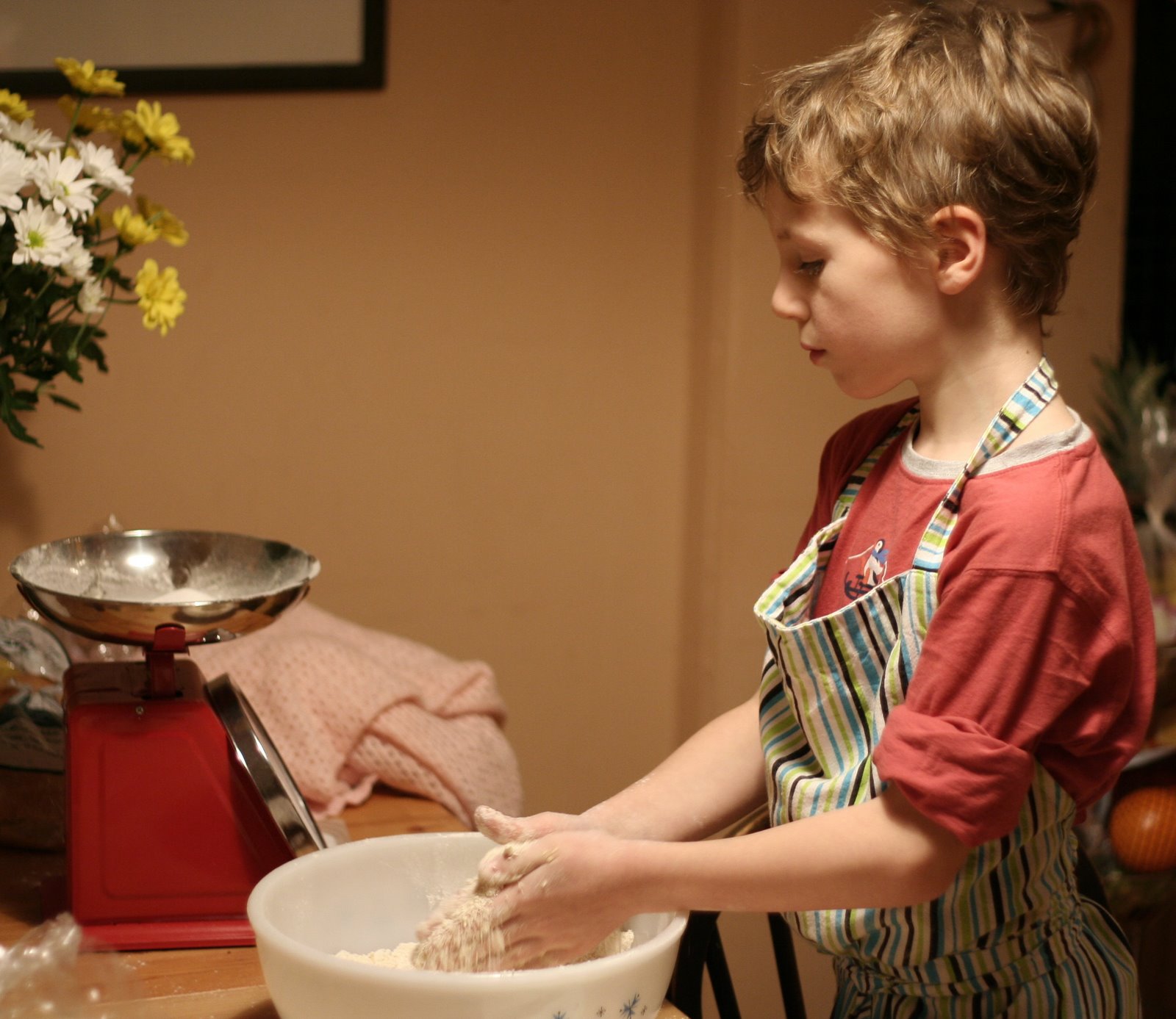
 The secret to a good scone, in my opinion, is to knead the dough lightly and shape by hand. If you don't knead the dough enough, the scone will be too crumbly; knead it too much or - heaven forbid! - roll it out, and your scone will be too heavy.


Ingredients

300g self-raising flour
50g caster sugar
75g butter
160ml milk

Method

  1. Heat the oven to 180oC. Sift the flour into a mixing bowl, add the sugar, cut the butter into small pieces and add to the flour and sugar mixture, rubbing it gently with your fingertips until it is the texture of breadcrumbs.
  2. Add the milk, mix with a spoon, and then knead gently until you have a smooth dough.
  3. Divide the dough into eight even pieces, form each piece into a ball, and flatten slightly to form a fat, rough disk. Any cracks and folds will add texture to the finished scone.
  4. Place the rounds on a lightly floured baking sheet and bake for about 14 minutes, until they are golden.

I've been making scones for years but I have to confess that it took me a while (okay, years!) to realise that, while not rolling and cutting them was fine, I'd gone too far in the other direction and that by barely kneading the dough at all my scones were crumblier (and heavier) than they should have been. Nonetheless, I have lots of happy memories of making scones with my kids for friends and family, so here are a couple of photos from the archive.


Saturday, August 1, 2015

American-style breakfast pancakes

Before I had children, when I was on holiday I would pore over my guidebooks in the morning (this was pre-internet) and try to figure a way of fitting in breakfast, lunch and dinner without exploding like Mr Creosote. When you travel with kids, you have to put their needs first (otherwise nobody has any fun) so on our recent trip in the States mealtimes were dominated by street food, picnics and snacks.


We did have plenty of diner breakfasts, though, and I realised that my pancakes had become a little bit, well, sad. One of the first things I did when I got home was to search out a decent recipe for American-style pancakes and then adjust and tweak it. I'm pretty happy with the results - light but still with plenty of texture and flavour.


Ingredients
375 ml whole milk
1 egg
20 ml vegetable oil
2 tbsp white vinegar
175 g self-raising flour
75 g fine maizemeal
a pinch of salt
2 tablespoons caster sugar
1 tsp baking powder


Method
  1. Measure the milk into a jug, add the beaten egg, the vegetable oil and the vinegar, and leave to stand for 5 minutes.
  2. Measure the self-raising flour, maizemeal, salt, sugar and baking powder into a mixing bowl. 
  3. Add the milk and egg to the dry ingredients and mix briefly until just combined.
  4. Put a heavy-based frying pan on a medium heat and brush with a little oil. Pour a ladleful of the batter into the pan, and cook at a low heat until it starts to form a skin on top. Flip over and cook the other side and cook until golden.
Notes on ingredients
The vinegar and milk mixture is an attempt to recreate buttermilk. If you have access to buttermilk, then use that instead. The maizemeal adds texture, flavour and colour, so resist the temptation to replace it with flour.


Thursday, March 14, 2013

Crepes

Crepes are back in fashion - and I don't even have to cook them.


Ingredients
200g plain flour
380g milk
2 eggs

Method
Whisk all the ingredients together, fry in a hot, lightly-oiled pan, flip and serve with the topping of your choice.


Sunday, February 10, 2013

Eggy bread

I find it hard, first thing in the morning, to think of more than about three breakfast options - pancakes (or some variation on them), cereal, or toast. Here is a simple alternative to toast, which my mum used to make for me, and that I now make for my kids.


Ingredients
4 slices of bread
2 eggs
salt

Method
Beat the eggs in a flat dish. Add a little salt, soak the bread in the egg, then fry in a little oil, until it is done on both sides.


Monday, June 6, 2011

Hot cross buns

One way of celebrating Easter is to dress up in a Ku Klux Klan costume and march around the street in the middle of the night carrying a giant statue of the Virgin Mary to the accompaniment of a discordant brass band:


Or you can just make some hot cross buns:

Ingredients 

For the dough
375g warm milk
15 g of fresh yeast (or 7 g of dried active yeast)
30g brown sugar
2 tsps mixed spice
150g large raisins
zest of 1 lemon
3 tbsps sunflower oil
1 egg
650g strong white flour
5g salt

For the glaze
100g light brown sugar
100g water

For the pastry cross
75g plain flour
75g water

Method
  1. Measure the milk into a large bowl. Add the yeast, whisk well so that it is dissolved. Add the sugar, mixed spice, raisins, lemon zest, sunflower oil and 1 egg, and whisk to mix. Add the flour and salt, and mix well.
  2. Work the dough in the bowl or on a worktop until it is smooth. Return the dough to the bowl, cover, and leave to stand for an hour.
  3. Transfer the dough to a well-floured surface, bring it together into a ball, then divide it into 12 portions. Form each portion into a small round boule or bun, and place the buns, evenly spaced, onto a lightly oiled, floured baking sheet. Put the sheet inside a large plastic bag, making sure that the plastic is not in contact with the dough. Leave the buns to rise for 1 hour.
  4. When the buns have been rising for 30 minutes, set the oven to 190°C. 
  5. To make the glaze, mix the brown sugar and water, and heat gently until all the sugar has dissolved to form a very runny syrup. 
  6. Mix the plain flour and water together to make a stiff batter, then pipe it slowly onto the buns to make crosses. (If you don't have a piping bag, just use a freezer bag with the corner snipped off.)
  7. Glaze the buns with plenty of the syrup.
  8. Put the tray of glazed buns in the oven and bake for 20 minutes until they are golden brown. 
  9. Remove the buns from the oven, apply a second coat of glaze and eat hot or leave to cool on a wire rack.

Friday, June 3, 2011

Scotch pancakes

After many years of staunchly preferring thin English pancakes or French-style crepes, my kids have suddenly flipped over and been converted to the juicy wonders of Scotch pancakes (or fat pancakes, as they call them). This is the recipe they use.


Ingredients
200g self-raising flour
1/2 tsp baking powder
pinch of salt
300g milk
2 eggs
1 tsp vegetable oil

Method
  1. Sift the flour into a large bowl. Add the baking powder and salt, mix well.
  2. Whisk the eggs thoroughly.
  3. Add the milk, eggs and vegetable oil to the flour and mix until you have a smooth, thick batter. Leave to stand for 5 minutes, until the surface is covered with little bubbles.
  4. Heat a lightly oiled, non-stick frying pan. When it is hot, pour half a ladle of pancake batter into it and cook for between 30 seconds and 1 minute. Flip over, and cook for another 30 seconds or so.

Wednesday, August 11, 2010

Cinnamon knot buns (zeeuwse bolus)

I don't usually just lift other people's recipes, but I have to start this post by admitting that I have copied this more or less directly from a wonderful blog I came across called Bake My Day! This is stage one of my plan for reproducing the delicious little buns filled with candied ginger which I ate in Amsterdam. I thought I would start with the dough, and as this recipe is for a Dutch sweetened bread of Jewish origin, it seemed a good place to start. (We bought the matrushka oilcloth in the background of the photo below at the street market in Albert Cuypstraat.)


Ingredients
500 g plain flour
7 g salt
7 g fast action yeast
320 g milk
75 g butter or margarine
zest of one lemon
250 gr soft brown sugar
2 tbs cinnamon

Method
  1. In a large bowl, mix the flour, salt, fast action yeast, milk, butter or margarine and lemon zest. Start by mixing it thoroughly with a spoon, then when it comes together mix by hand and knead until you have a nice light dough. Put the bowl inside a plastic bag, leave in a warm place (if you have one) for 45 minutes (a little longer if you don't have a warm spot in your kitchen). In a separate bowl, mix the brown sugar and cinnamon and set aside.
  2. Weigh the dough and divide into 16 equal pieces. Form each piece into a ball, place on a tray, cover with plastic and leave to relax for 20 minutes or so. After 20 minutes, take each ball and roll it gently out into a rope, about 20 cm long - see photo below. (You should be able to do this between your hands, but feel free to roll it on a flat surface if needs be.)
  3. Now sprinkle plenty of the sugar and cinnamon mixture over a clear work surface, and one by one roll the dough ropes in it until they at least 30 cm long, making sure they get thoroughly coated with the sugar.
  4. Finally, form the ropes into knots, as per the photo below. (This is very easy - just find the mid-point, wrap one end of the rope around your finger, remove the finger from the resulting hole and poke the end of the rope through. Then repeat for the other side.) Place the coils on an oiled baking sheet, cover with plastic and leave to rise for about 60 minutes until they have more or less doubled in size. You will probably have to use two baking sheets and bake in two batches. (Because my sugar wasn't quite sticky enough, I cheated and sprayed the finished knots with a little water and sprinkled them with some extra sugar just before baking.) Turn the oven on to 250oC.
  5. Bake the knots for 8 minutes. They should be brown and even a little crisp on the outside, but still very soft on the inside.

'raw' ropes

rolling the rope in sugar, and forming the knots

risen knots

Friday, November 20, 2009

Fried matzo

I have an unofficial rule on my blog that anything on it has to have been cooked by me. However, this is the first thing that Sammy has learnt to cook all on his own, so I think it deserves an exception to be made for it. I remember my grandma (and my mum) making this for me when I was a kid, so seeing Sammy make it brings back happy memories.


Ingredients
1 piece of matzo
1 egg
salt
oil for frying

Method
  1. Break the matzo into large pieces, place in a colander and sprinkle with a little water to soften it up.
  2. Beat one egg in a bowl with a little salt, and add the matzo pieces to it.
  3. Heat the oil in a non-stick pan, and pour the matzo and egg mixture into it. When it is cooked underneath, flip it over, cook for a few seconds more and serve.


Unleavened bread

Breakfast is sometimes a bit of a problem, so we were really relieved to find "pane azzimo" in the local supermarket. That's just Italian for "unleavened bread", and is identical to matzo (although without all the Beth Din stamp tomfoolery). At some point I may even have a go at making unleavened bread, although first I have to track down a recipe which doesn't involve a long trek through the desert and across the bed of the Red Sea.

Sunday, November 2, 2008

Banana fritters

I did have a search on the web for other banana fritter recipes, but all I found were some rather disturbing reports of the practice of some streetfood sellers in Malaysia of adding a plastic bottle to the frying oil for added crispiness. Just goes to show that the innovative spirit of Hester Blumenthal and Ferran Adria is alive and well in south-east Asia.


The recipe below is based on the Cadiz speciality of shrimp pancakes, but made with bananas instead of shrimps.


Ingredients
100 g chickpea flour
100 g plain flour
1 teaspoon of finely chopped fresh ginger
1 teaspoon of ground cinnamon
water (about 300 ml)
2 bananas
oil for frying

Method
  1. Mix the flours. Mash the bananas and stir in the ginger and cinnamon. Add the water to the flour, and beat to make a loose batter, then add the banana, ginger and cinnamon.
  2. Heat plenty of oil in a non-stick frying pan, add large spoonfuls of batter to it, fry for about 30 seconds, turn over and fry for another 30 seconds or so before removing from the oil.

Wednesday, October 8, 2008

Bubelach: matzah meal pancakes

I remember my grandma making these for my grandpa, Sam, and for my brother, Mark, and me. I had a bit of trouble tracking down a recipe, as we always called them 'egg latkes'. As far as I can tell, the proper name is 'bubelah' (or the plural 'bubelach', as there are always several of them), which means 'darling' in Yiddish.


I can't easily get matzah meal in Spain, so I used breadcrumbs instead. It's sold in bags and comes in varying degrees of fineness, so makes a good substitute.

Ingredients
3 eggs
175 ml water
80g matzah meal
1/4 tsp salt

Method
  1. Separate the eggs, and add the water to the egg yolks. Beat lightly, add the matzah meal and salt, and mix well. (This step can be done the night before and left in the fridge overnight.)
  2. Beat the whites to stiff peaks and fold into the yolk, water and matzah meal mixture.
  3. Heat some vegetable oil in a non-stick frying pan. When it is hot add as many tablespoonfuls of the mixture as will easily fit into the pan, and fry until golden brown on each side. Avoid turning more than once.
These are really best if cooked in plenty of oil, as that way they puff up. However, I wasn't really up for frying this morning, so I just did them with a little oil to prevent them from sticking, which produces something which looks more like a light Scotch pancake than a little fritter.

Tuesday, September 23, 2008

Tattie scones (potato scones)

These are a classic Scottish breakfast food, and often appear as part of a cooked breakfast, although they're also great on their own, with a little bit of butter. Now that I've got round to making them, I've realised that in many ways what they're most similar to is a chapati.


After a bit of trial and error, I realised that the key to this is to think of the potato and flour mixture as a dough, and to treat it accordingly. Also, you have to add plenty of flour during the shaping and rolling stage to prevent the scones from sticking.

Ingredients
500g of leftover mashed potato
100g of flour
salt

Method
  1. Gradually work the flour into the potato, gently kneading the dough until you have a good smooth dough. (The exact quantity of flour required will depend on how dry your mashed potato is, so best to add the flour gradually.)
  2. Flour a worksurface or board, put more flour on your hands, and take off a smallish ball of the mixture (somewhere between the size of a golfball and a satsuma).
  3. Press the ball so you have a fat disc, flour each side well then, using a well-floured rolling pin, gently roll it to a flat circle, about 1/2 cm thick, turning it between each roll and adding more flour to the worksurface or board if required.
  4. Heat a heavy-bottomed pan, grease with a little oil (but not too much), and then cook the scones on a low heat for about 3 minutes each side.