Sunday, August 29, 2010

Courgette with tomato and coriander

I always have mixed feelings about vegetarians at barbecues. On the one hand, it's great for there to be extra meat for the carnivores. On the other hand, vegetarians are often a little stringy and frankly flavourless. It is therefore a good idea to feed them up first with something suitable.


Ingredients 1 kg of courgettes
1 kg of chopped tomatoes
2 onions
3 cloves of garlic
olive oil
1 teaspoon salt
bunch of fresh coriander

Method
  1. Roughly chop the onions and fry gently in plenty of olive oil. When nearly done, add the peeled, chopped garlic, fry for another 30 seconds or so, then add the chopped tomatoes, thickly sliced courgettes and salt.
  2. Stew gently for 30 minutes or so. A few minutes before serving, add the chopped fresh coriander.

Chinese takeaway
As a purist, I think that everything eaten at a barbecue should pass at least briefly across the grill (with the exception, obviously, of salad). Unfortunately, stews have a nasty habit of trickly through the grid straight onto the charcoal, so I prefer to put them in a metal container and ceremonially reheat them on the grill before serving.

Sunday, August 22, 2010

Dutch Jewish ginger buns (gember bolus)

I came across these ginger buns (gember bolus) in the cafe of the Jewish Museum in Amsterdam. I googled "ginger bolus", but all I came up with were reports of people choking to death in Thailand. Eventually, I found something which appeared to be related on a blog called Bake My Day! So I contacted the author of the blog where I had found that recipe and she very kindly got back to me with a version of what I was looking for. Needless to say, I then fooled around with the recipe a bit (well, quite a lot) and this is what I came up with.

Ingredients
dough
500g plain flour
7g active yeast
320g milk
30g water
20g brown sugar
20g margarine or butter

syrup
200g brown sugar
200g water

filling
250g ginger crush in syrup

for sprinkling
more brown sugar

Method
  1. Put the syrup ingredients in a small saucepan, bring to a boil, cover and remove from the heat.
  2. Combine all of the dough ingredients. If you have a food processor with a dough hook, then knead for a couple of minutes on the slowest settng. Alternatively, mix the ingredients thoroughly with a spoon, then stretch and fold in the bowl until you have a smooth dough. Cover the dough and leave to rise for about 1 hour.
  3. Oil 16 muffin cases and put them on 2 muffin trays. Set the oven to 200oC.
  4. Transfer the dough to a lightly floured surface and divide  into 16 equal pieces. Very lightly turn each of the pieces in the flour, then press out to form a rough circle. Put a teaspoon of the filling mixture in the centre of each circle, and form the circle into a ball, crimping it closed with your fingers. Place each of the balls into one of your prepared muffin cases, and when the tray is full cover it with clingfilm and leave to rise in a warm place for 45 minutes.
  5. Remove the clingfilm from the trays, glaze each ball with 1 dessertspoon of syrup, sprinkle about 1/4 teaspoon of brown sugar over each of them , transfer trays to oven and bake for 15-20 minutes.
  6. Remove the trays from the oven, transfer the buns from their cases to a cooling rack. Pour a little more syrup over the buns before serving.


Friday, August 20, 2010

Carrot soup

The other day my kids bought a big bag of beautiful carrots, complete with their green leafy bits, all contained in a lovely bag with a picture of the very farmer who had grown them and a little eulogy to the wonders of the English countryside and to the virtues of the large supermarket chain supplying us with these goodies. A week later, the carrots were still sitting in the bottom of the fridge looking almost as lovely as the day they had been bought, and I was beginning to feel guilty as I read about Farmer Roberts for the third time and imagined just how disappointed he would be with me if his carrots ended up in the bin. So I made this soup.


Ingredients
1 head of celery
2 cloves of garlic
olive oil
750g carrots
500g potatoes
2 tsps cumin
2 tsps smoked paprika
1 tsp salt
1 glass white wine
2 tbsps tomato puree
1 litre of vegetable stock

Method
  1. Wash the celery, separate into stalks and cut into thinnish slices. Peel and chop the garlic. Top and tail the carrots, peel if necessary, and cut into chunks. Peel the potatoes and cut into chunks.
  2. In a large saucepan, gently fry the celery. When it is nearly done, add the garlic, fry for another minute, then add the cumin and paprika, and fry for 10 seconds or so.
  3. Add the carrots, potatoes, salt, wine, puree and stock, bring to a boil, turn heat to minimum, cover and simmer gently for 40 minutes, until the carrot and potato pieces are nice and tender.
  4. Allow soup to cool, then liquidise with a stick blender.

Honey and soy salad dressing

Carmela likes to put honey in her salad dressing, so I thought I should actually note down the ingredients rather than doing it on a trial and error basis each time. The combination of honey, soy sauce and sesame oil give it an oriental, almost sweet and sour feel.


Ingredients
1 teaspoon of honey
2 tablespoons of olive oil
1 teaspoon of sesame oil
1 teaspoon of dark soy sauce
2 teaspoons of balsamic vinegar

Method
Put your honey inb a small bowl and, unless it is very runny, heat for a few seconds in a microwave. Add the other ingredients, and whisk well with a fork. Pour over the salad just before serving and toss to mix. (I tend not to put salt into my dressings, but instead to add them direct to the salad before dressing.)

Sunday, August 15, 2010

Arbroath smokies

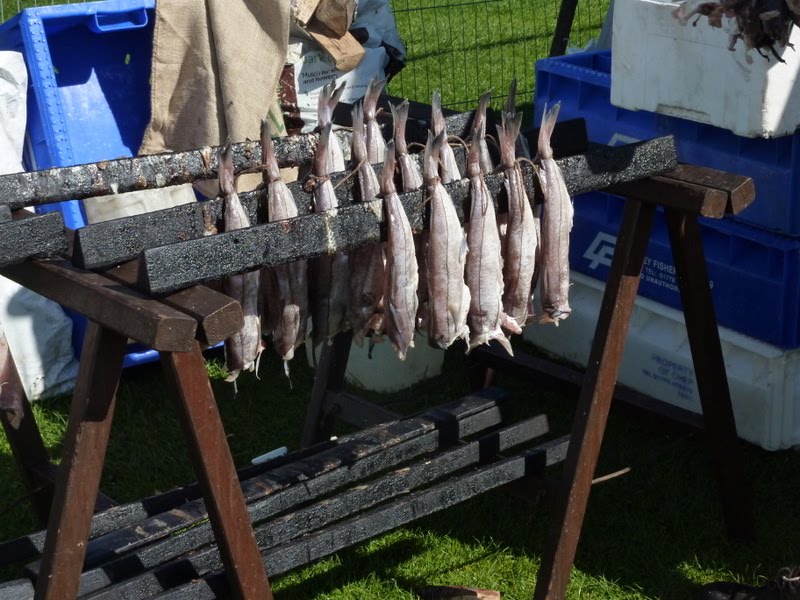
I was at the Foodies Festival in Edinburgh and was lucky enough to see Iain Spink smoking his haddock on site. The process itself is pretty simple: the fish have their heads removed and are gutted and cleaned, before being tied in pairs and hung over a stick.


Next, the stick itself is placed over a half barrel, with a fire of beech and oak burning inside it.


Then the barrel is covered with a few layers of damp hessian.


After half an hour or so, the Arbroath smokies are ready.


Arbroath smokies keep for a while, and perhaps the most famous dish in which they feature is Cullen skink. They are also good in a potato salado. However, the best way to serve them is definitely hot from the barrel.

Thursday, August 12, 2010

Roasted vegetables

I've got out of the habit of roasting vegetables (or anything, for that matter) due to having had a broken oven for the first six months of this year. I now have access to a working oven again and, in between my obsessive search for the perfect sourdough, I found time to roast some vegetables. I think the key to this is moderation - the vegetables should not be so small that they burn, but not so big that they will take hours to cook and won't absorb flavours, and there should be enough vegetables in the tray for them to mingle, without there being so many that they don't cook properly. I used carrots, potatoes and pumpkin because that was what I had. This would also work well with parsnips or turnips.


Ingredients
carrots
potatoes
pumpkin
olive oil
thyme
balsamic vinegar
salt
black pepper

Method
Peel the vegetables and cut into chunks. Place in a large baking tray, and dress with plenty of olive oil, some balsamic vinegar, thyme, salt and black pepper. Bake at 200oC for about 1 hour.

Wednesday, August 11, 2010

Cinnamon knot buns (zeeuwse bolus)

I don't usually just lift other people's recipes, but I have to start this post by admitting that I have copied this more or less directly from a wonderful blog I came across called Bake My Day! This is stage one of my plan for reproducing the delicious little buns filled with candied ginger which I ate in Amsterdam. I thought I would start with the dough, and as this recipe is for a Dutch sweetened bread of Jewish origin, it seemed a good place to start. (We bought the matrushka oilcloth in the background of the photo below at the street market in Albert Cuypstraat.)


Ingredients
500 g plain flour
7 g salt
7 g fast action yeast
320 g milk
75 g butter or margarine
zest of one lemon
250 gr soft brown sugar
2 tbs cinnamon

Method
  1. In a large bowl, mix the flour, salt, fast action yeast, milk, butter or margarine and lemon zest. Start by mixing it thoroughly with a spoon, then when it comes together mix by hand and knead until you have a nice light dough. Put the bowl inside a plastic bag, leave in a warm place (if you have one) for 45 minutes (a little longer if you don't have a warm spot in your kitchen). In a separate bowl, mix the brown sugar and cinnamon and set aside.
  2. Weigh the dough and divide into 16 equal pieces. Form each piece into a ball, place on a tray, cover with plastic and leave to relax for 20 minutes or so. After 20 minutes, take each ball and roll it gently out into a rope, about 20 cm long - see photo below. (You should be able to do this between your hands, but feel free to roll it on a flat surface if needs be.)
  3. Now sprinkle plenty of the sugar and cinnamon mixture over a clear work surface, and one by one roll the dough ropes in it until they at least 30 cm long, making sure they get thoroughly coated with the sugar.
  4. Finally, form the ropes into knots, as per the photo below. (This is very easy - just find the mid-point, wrap one end of the rope around your finger, remove the finger from the resulting hole and poke the end of the rope through. Then repeat for the other side.) Place the coils on an oiled baking sheet, cover with plastic and leave to rise for about 60 minutes until they have more or less doubled in size. You will probably have to use two baking sheets and bake in two batches. (Because my sugar wasn't quite sticky enough, I cheated and sprayed the finished knots with a little water and sprinkled them with some extra sugar just before baking.) Turn the oven on to 250oC.
  5. Bake the knots for 8 minutes. They should be brown and even a little crisp on the outside, but still very soft on the inside.

'raw' ropes

rolling the rope in sugar, and forming the knots

risen knots